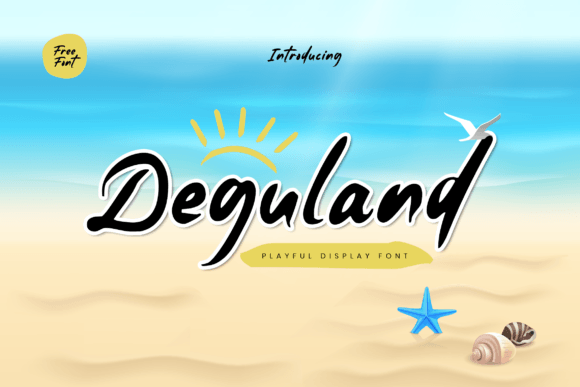
Deguland Font: A Fresh Marker-Handwriting Display Typeface
As a UI designer who ships landing pages, SaaS dashboards, and conversion-optimized online stores, I test dozens of Fonts each month—but Deguland stands out instantly. Deguland is a fresh and natural display font based on marker handwriting. It’s not a generic script or overused brush typeface; it’s deliberately loose, human-scaled, and rhythmically uneven—like ink freshly laid down with a chisel-tipped marker. That authenticity translates directly to digital interfaces where warmth, approachability, and creative distinction matter most. And yes—it’s available as a high-quality Freebies download, making it ideal for rapid prototyping, client pitch decks, and live production sites without licensing friction.
Deguland for Hero Section Headlines and Landing Page Titles
When your hero section needs to communicate personality before the first scroll, Deguland delivers clarity *and* character. Its generous x-height, open counters, and subtle baseline variation ensure legibility even at 48px+ on desktop and 36px on mobile—provided you pair it with sufficient line height (1.3–1.4) and contrast (minimum 4.5:1 against background). Use Deguland for primary headlines only—not body text—and always pair it with a neutral sans serif like Inter, Manrope, or IBM Plex Sans for supporting copy. This pairing creates instant visual hierarchy: Deguland grabs attention and signals brand tone; the sans serif ensures scannability and trust. For SaaS founders launching a new course platform or a boutique coaching site, this combo converts better than sterile all-sans layouts.
Deguland for Quote Graphics and Social Media Banners
Deguland thrives in short-form, emotionally resonant contexts—exactly where quotes, notes, tees, or anything that needs expressive emphasis lands hardest. On Instagram carousels, X banners, or embedded blog pull quotes, Deguland adds tactile sincerity without sacrificing digital polish. Because it’s built from real marker motion—not algorithmic wobble—it avoids the “AI-script” fatigue users subconsciously reject. For marketers building branded content libraries or designers crafting digital brand kits, Deguland serves as a reliable decorative accent: apply it to pull quotes in Notion docs, testimonial highlights in Webflow sites, or animated SVG headers in Figma prototypes. Just avoid tight tracking (<0.5px) and never stretch or skew the glyphs—the charm lives in its organic proportions.
Deguland for Online Store Banners and Product Tees
If you run an online store selling handmade goods, stationery, or apparel—or if you’re designing merch for a creator brand—Deguland bridges craft and commerce seamlessly. Its marker-handwriting DNA makes it ideal for product name tags, limited-edition drop banners, or “hand-drawn” sale badges. Unlike many script fonts, Deguland maintains strong letter separation, so “Summer Sale” or “New Drop” stays readable at 24px on mobile product cards. When used on mockups for t-shirts or tote bags, it implies authenticity and small-batch care—valuable perception cues for conscious shoppers. As a Freebies font, it’s safe to embed in Shopify themes via @font-face (WOFF2 recommended) or load via Google Fonts-compatible hosts—just verify the license permits commercial web use before deploying to live stores.
Deguland for Portfolio Websites and Creative Branding
Creative professionals—from illustrators to UX writers—need portfolios that reflect voice *and* craft. Deguland works powerfully in portfolio headlines, project titles, and “About Me” subheads because it signals intentionality: this isn’t default typography—it’s chosen. Pair it with a warm serif like Cormorant Garamond for editorial depth, or keep it modern with a geometric sans like Poppins for clean contrast. For dark-mode interfaces, test Deguland against charcoal (#1e1e1e) or deep navy backgrounds—not pure black—to preserve its ink-like texture. Avoid white-on-transparent PNGs; export as SVG with embedded font outlines for crisp rendering across devices. Since Deguland is a fresh and natural display font based on marker handwriting, it performs best when given breathing room: generous padding, ample whitespace, and minimal competing decoration.
Deguland for Email Headers and Digital Ad Copy
In email campaigns and static digital ads—where milliseconds decide engagement—Deguland cuts through noise. Its irregular ascenders and descenders create visual hooks that guide the eye naturally toward CTAs. Use it exclusively for H1-level headers (“You’re Invited”, “Last Chance”, “Just Dropped”)—never for buttons or body links. For accessibility compliance, always wrap Deguland-styled text in semantic heading tags (–) and provide fallback sans-serif styles in your CSS stack. Because Deguland is distributed as Freebies, it’s perfect for A/B testing headline variants in Mailchimp or Klaviyo without budget constraints. Just confirm the included file formats support web embedding (look for WOFF2, OTF, and TTF) and check for OpenType features like stylistic alternates—small details that elevate perceived professionalism.
Deguland for Branded Notes and Digital Stationery
Think beyond print: digital notebooks (Obsidian, Logseq), Notion templates, and branded PDF workbooks rely on typography to reinforce tone. Deguland excels here—not as body text, but as section dividers, checklist headers, or “Key Insight” callouts. Its marker-handwriting quality suggests thoughtfulness and personal curation, which aligns perfectly with knowledge-based brands, educators, and consultants. For responsive PDFs viewed on tablets, embed Deguland as a subset font to reduce file size while preserving core glyphs. And because Deguland is a fresh and natural display font based on marker handwriting, it pairs intuitively with minimalist line icons or soft watercolor textures—no heavy illustration needed. This makes it a versatile asset across Fonts libraries used for both web and document design.
Practical Licensing Note for Web Designers
Before shipping Deguland into client projects, verify the license explicitly permits commercial web use—including SaaS dashboards, e-commerce banners, and template marketplaces. Most reputable Freebies fonts allow this, but some restrict usage to personal projects only. Always download from the original creator source, check the included LICENSE.txt, and retain proof of permission for client handoff. When in doubt, treat Deguland as a premium font: credit the designer, link to their portfolio, and consider supporting future Fonts releases.